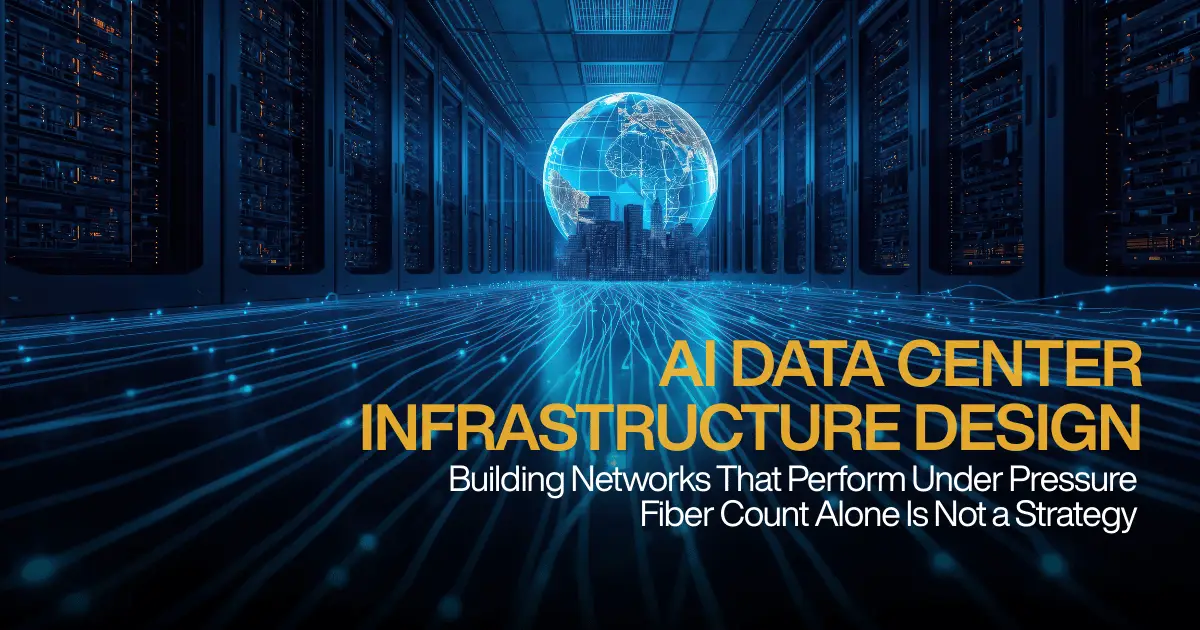
Building Networks That Perform Under Pressure Fiber Count Alone Is Not a Strategy
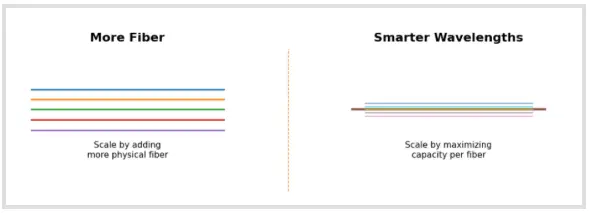
For decades, service providers competed on one primary metric: fiber count and geographic reach. More fiber meant more capacity, more opportunity, and a stronger market position. But in the AI era, that mindset is no longer enough for AI infrastructure design.
Expanding fiber is slow, capital-intensive, and often constrained — especially in edge markets. Forward-thinking leaders are shifting their focus. Instead of asking how much fiber they own, they are asking how intelligently they can use what they already have.
That means designing networks around:
- Higher wavelength density per fiber
- Dynamic capacity reallocation during failures
- Optical systems engineered with disruption in mind
As Chrissy Kidd of Cisco Insider Voices explains, AI workloads are fundamentally different. Large-scale training and inference create sustained high-density compute, intense east–west traffic, and massive power and cooling demands. For many organizations, this is not an upgrade cycle — it is a structural redesign.
The competitive question has changed. It is no longer: ‘How much fiber do we own?’
It is: ‘How intelligently can we operate under stress?’
Fiber Interconnects: Where AI Performance Is Won or Lost
Gary Bolton, President and CEO of the Fiber Broadband Association, has emphasized the growing role of AI in advancing fiber networks and technology. AI-driven automation and optimization are becoming essential tools for managing complex systems, improving customer experience, and maximizing bandwidth.
AI workloads amplify every weakness in interconnect design. Latency tolerances shrink. Redundancy becomes mission-critical. Recovery windows tighten dramatically. What once passed as acceptable performance — including longer Mean Time to Repair (MTTR) — is no longer sustainable when downtime directly impacts revenue, compute efficiency, and customer confidence.
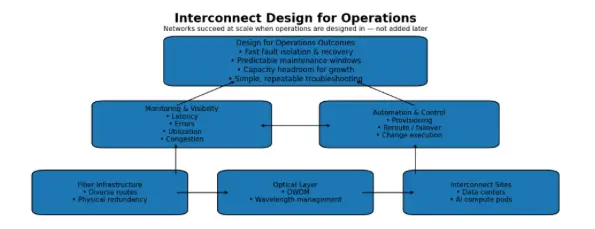
Leading providers go beyond traditional redundancy. They engineer interconnects capable of live optical rebalancing. They design optical margins with enough headroom to support emergency wavelength shifts. They structure physical layouts for rapid human intervention so crews can isolate faults and restore service quickly.
Across the telecom industry, one truth remains: when AI performance drops, customers don’t blame the application — they blame the network.
Aerial vs. Underground: AI Infrastructure Design for Resilience and Recovery
As AI workloads move closer to users, edge data centers are being deployed in areas with limited fiber diversity and increased operational risk. This shift is forcing a serious rethink of aerial versus underground design.
To build an AI infrastructure design that performs under stress, providers must weigh the real-world advantages and tradeoffs of both aerial and underground fiber deployment.
Aerial vs. Underground: AI Infrastructure Design for Resilience and Recovery
PROS
- Reduced exposure to weather-related events
- Lower risk from wind and falling debris
- Preferred in dense urban environments
CONS
- High exposure to construction-related damage
- Longer fault isolation and repair timelines
- Restoration is often measured in hours or days
Protection doesn’t matter if recovery takes too long. In AI networks, minutes matter.
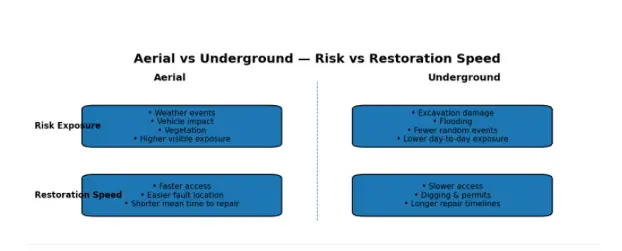
Aerial Fiber: Exposure with Speed
PROS
- Faster visual fault identification
- Shorter emergency restoration timelines
- Easier access for temporary and permanent repairs
- Faster and lower-cost deployment
CONS
- Higher exposure to weather and vehicle strikes
- Risk profile varies by geography
- Requires proactive inspection and maintenance
Faster repair often beats theoretical protection. A network that can be reached and repaired quickly often outperforms one designed only for resistance.
Hybrid Design: The New Operational Standard
With updated Broadband Equity, Access, and Deployment (BEAD) guidelines released in 2025, the industry landscape has shifted. Leading providers are no longer choosing between aerial and underground approaches.
They are intentionally blending both to balance risk diversity, restoration speed, and capital efficiency. This is not redundancy on paper — it is operational reality.
“Resilience in an AI infrastructure design is not about avoiding failure. It is about recovering faster than your competitors.” – Jim Cox, OSP Technologies
In real-world operations, failure is not a question of if — it is when. Storms hit. Contractors dig. Vehicles strike poles. What separates strong networks from struggling ones is not the absence of disruption, but the speed and coordination of response. Hybrid design acknowledges that reality. By intentionally combining aerial accessibility with underground protection, providers create networks that are not only engineered to endure stress but also structured to restore service quickly and confidently when the unexpected happens.
Emergency Restoration: The KPI That Matters Most
AI customers do not experience architecture diagrams. They experience downtime when design assumptions fail.
Emergency restoration timelines directly affect:
- Model training schedules
- Inference SLAs
- Customer trust
- Revenue protection
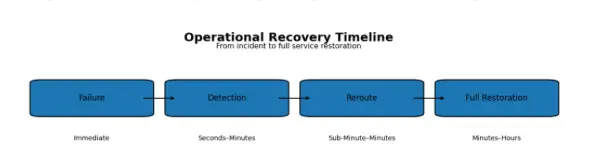
Standout AI infrastructure design networks are where wavelength failover is pre-engineered, optical reroutes happen in minutes, and field repairs are operationally simple. To move from theory to practice, start today by auditing your current emergency restoration timelines against the demands of AI workloads. Identify where minutes could be saved and make rapid recovery the standard, not the exception.
In AI infrastructure, recovery speed is not just an operational metric — it is a feature.
Sources:
Chrissy Kidd – Cisco Insider Voices
Fiber Broadband Association AI White Paper
Broadband Equity, Access, and Deployment (BEAD) Program