Most people never think about what exists beneath their feet.
They drive over it every day. Build on top of it. Invest around it. Depend on it constantly. Yet few ever consider the hidden world below the surface — a world that has become one of the most crowded, dangerous, and strategically important environments in modern civilization.
Beneath every city street, refinery, industrial park, neighborhood, rural highway, airport, and data center lies an expanding underground network carrying the systems society depends upon:
- Power
- Water
- Sewer
- Fiber optics
- Communications
- Gas
- Storm drainage
- Industrial product lines
- Transportation systems
- Private infrastructure
And every year, more is added.
To the average observer, underground construction can appear deceptively simple. A crew arrives. Equipment is unloaded. Dirt is removed. Pipe or conduit is installed. The trench disappears, and life moves on.
But underground placement is not merely construction.
It is navigation through an invisible and constantly changing three-dimensional maze — one where engineering, geology, safety, economics, regulations, and human judgment collide beneath the surface.
What seems straightforward from above ground becomes extraordinarily complex once excavation begins.
Because underground work is never just about where you are going.
It is about everything already there.
Every Project Begins With a Tie Point
Every underground installation starts with a purpose.
A new subdivision needs power.
A refinery expands operations.
A city upgrades its aging infrastructure.
A telecommunications company extends fiber.
A developer prepares raw land for construction.
An industrial facility requires redundancy.
A municipality faces drainage failures.
A refinery expands operations.
A city upgrades its aging infrastructure.
A telecommunications company extends fiber.
A developer prepares raw land for construction.
An industrial facility requires redundancy.
A municipality faces drainage failures.
The beginning of that system — the tie point — becomes the anchor for everything that follows.
From that single connection point, an entire chain of decisions begins:
- What elevation must be maintained?
- What clearances are required?
- Who owns the surrounding infrastructure?
- What conflicts exist underground?
- What permits are needed?
- What method of installation is safest?
- What risks are acceptable?
- What unknowns may exist?
On paper, the destination may appear only hundreds of feet away.
In reality, that short distance may cross one of the most congested underground environments imaginable.
And unlike vertical construction, underground work rarely offers the luxury of seeing the obstacles before encountering them.
The Underground Is No Longer Empty
Decades ago, underground placement was often relatively uncomplicated. Infrastructure systems were fewer, cities were smaller, and subsurface corridors had room to spare.
That world no longer exists.
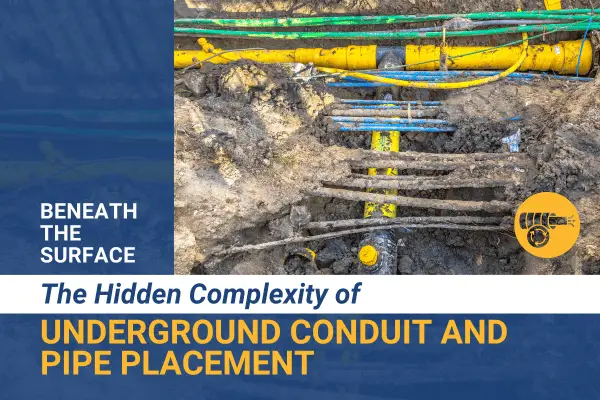
Today, underground corridors in developed areas resemble layered transportation systems stacked upon one another over generations of growth.
A single section of roadway may contain:
- Electrical duct banks
- Fiber optic corridors
- Water mains
- High-pressure gas lines
- Storm systems
- Legacy telecommunications
- Petroleum lines
- Municipal infrastructure
- Private facilities
- Abandoned systems no one remembers
And many of those systems were installed decades apart by different companies, contractors, municipalities, and engineers operating under entirely different standards.
The result is an underground environment that resembles organized chaos.
What makes the challenge even greater is that underground placement is not simply horizontal.
It is vertical.
Every route becomes a three-dimensional puzzle involving:
- Depth
- Clearance
- Crossings
- Angles
- Future access
- Structural protection
- Settlement concerns
- Existing utility elevations
A line cannot simply move left or right to avoid conflict.
Sometimes it must pass over another utility while maintaining separation requirements. Other times, it must drop beneath multiple systems while preserving slope, pressure, or bend limitations.
A decision measured in inches can determine
Maps Only Tell Part of the Story
Modern projects begin with records, utility locates, GIS mapping, and as-built drawings.
But underground veterans understand a difficult truth:
Records are often incomplete.
Some infrastructure was installed before digital mapping existed.
Some systems were never documented accurately.
Some companies no longer exist.
Some abandoned lines remain buried and forgotten.
Some facilities were relocated in the field without updated drawings ever being created.
Some systems were never documented accurately.
Some companies no longer exist.
Some abandoned lines remain buried and forgotten.
Some facilities were relocated in the field without updated drawings ever being created.
Even well-maintained records can drift from reality over time.
A utility shown at four feet deep may actually be six feet deep — or two feet deep — depending on decades of repairs, resurfacing, erosion, settlement, or undocumented modifications.
This uncertainty changes everything.
Because underground work does not occur in a controlled environment.
It occurs in an environment filled with assumptions.
And assumptions underground can become catastrophic.
The Unknown Is the Greatest Hazard
The most dangerous infrastructure underground is often the infrastructure no one knows exists.
Crews regularly uncover:
- Abandoned steel casings
- Forgotten conduit banks
- Buried concrete structures
- Retired pipelines
- Legacy communication systems
- Unmapped service laterals
- Old industrial infrastructure
- Previously damaged utilities were hidden during prior construction
Sometimes these systems remain inactive.
Sometimes they do not.
An abandoned conduit may still contain energized cable. A retired pipeline may still hold residual product.
An unidentified crossing may belong to a critical communication network carrying emergency data.
No paint mark on the surface can fully eliminate that uncertainty.
That is why experienced crews develop a mindset built around caution, verification, and controlled exposure.
Because underground construction is one of the few industries where the danger is often invisible until the moment it is encountered.
Daylighting: Trust, Then Verify
Before major excavation begins, crews often physically expose existing infrastructure through daylighting or potholing.
This process may appear slow to outsiders.
It is not.
It is disciplined risk management.
Using hydro excavation, careful hand digging, or controlled mechanical methods, crews expose buried infrastructure to confirm:
Using hydro excavation, careful hand digging, or controlled mechanical methods, crews expose buried infrastructure to confirm:
- Exact depth
- Horizontal alignment
- Orientation
- Clearance availability
- Physical condition
Those few exposed feet of utility can determine the safety of an entire project.
Because striking underground infrastructure can trigger consequences far beyond the jobsite:
- Regional communication outages
- Electrical failures
- Gas releases
- Flooding
- Environmental contamination
- Transportation disruptions
- Massive financial losses
- Serious injuries or fatalities
The public often sees potholing as a delay.
Professionals see it as prevention.
Choosing the Right Method Is Part Science, Part Experience
No two underground projects are identical.
The method used to install conduit or pipe depends on a constantly shifting combination of conditions:
- Soil composition
- Congestion
- Depth
- Surface restoration requirements
- Environmental sensitivity
- Traffic exposure
- Distance
- Groundwater
- Schedule constraints
- Risk tolerance
In one section of a route, crews may hand-dig carefully around critical infrastructure.
A few hundred feet later, trenchers may operate efficiently through open ground.
Elsewhere, horizontal directional drilling may carry conduit beneath highways, rivers, railroads, or developed intersections without disturbing the surface.
Different methods serve different purposes:
- Hydro vacs reduce strike risk
- Pneumatic missiles minimize surface disruption
- Vibratory plows accelerate rural installation
- HDD systems navigate beneath obstacles
- Excavators provide flexibility
- Trenchers maximize production in favorable conditions
But every method introduces tradeoffs.
Faster production may increase risk.
Minimal surface disruption may increase technical complexity.
Reduced excavation may demand greater geotechnical precision.
Reduced excavation may demand greater geotechnical precision.
The equipment itself does not determine success.
Judgment does.
Soil Controls Everything
The underground environment is shaped as much by geology as engineering.
Two projects separated by only a few miles may behave very differently due to changing soil conditions.
Crews may encounter:
- Expansive clay
- Sand
- Rock
- Groundwater
- Caliche
- Unstable fill material
- Construction debris
- Mixed strata
Each condition affects:
- Excavation stability
- Bore steering
- Fluid pressure
- Settlement risk
- Equipment wear
- Productivity
- Restoration requirements
In directional drilling operations, drill fluid engineering becomes especially critical.
To outsiders, drilling fluid may appear to be nothing more than mud.
In reality, it is a carefully controlled system designed to:
- Stabilize bore paths
- Carry cuttings
- Control pressure
- Reduce friction
- Prevent collapse
- Protect the surrounding infrastructure
Improper fluid management can destroy an otherwise successful installation.
A failed bore may strand tooling underground, fracture pavement, damage nearby utilities, or trigger environmental incidents.
The underground does not tolerate shortcuts for long.
Public Space Adds Another Layer of Complexity
Underground routes rarely exist in isolation. Most projects move through a combination of:
- Public right-of-way
- Easements
- Private property
- Municipal corridors
- State-controlled infrastructure
- Industrial facilities
Each environment introduces its own rules, restrictions, and stakeholders.
A roadway crossing may require:
- Traffic control plans
- Lane closures
- Night work
- Permit coordination
- Inspection scheduling
- Pavement restoration standards
Private property may involve:
- Access negotiations
- Liability concerns
- Operational disruptions
- Restoration obligations
- Owner approvals
Sometimes the physical installation becomes easier than navigating the administrative process surrounding it.
Infrastructure is no longer just an engineering challenge.
It is also a coordination challenge.
The Public Sees Dirt. Professionals See Risk.
When the public passes an underground construction site, they often see inconvenience:
- Traffic delays
- Barricades
- Mud
- Noise
- Equipment
- Temporary closures
What they do not see is the decision-making occurring beneath the surface.
They do not see:
- The gas line six feet away
- The undocumented fiber crossing
- The unstable trench wall
- The groundwater infiltration
- The clearance conflict discovered that morning
- The emergency redesign happening in real time
Underground construction forces constant adaptation.
Conditions change hourly.
Plans evolve daily.
Unexpected discoveries are inevitable.
Plans evolve daily.
Unexpected discoveries are inevitable.
Success often depends less on whether problems appear — and more on how quickly experienced people respond when they do.
Underground Space Has Become Strategic Real Estate
As cities expand and technology advances, underground space itself is becoming increasingly valuable.
Not all underground systems exist to serve immediate needs.
Many organizations now install additional conduit intentionally — empty pathways reserved for future growth.
Because reopening developed corridors years later can become exponentially more expensive and disruptive.
Forward-thinking infrastructure planning now considers:
- Future capacity
- Redundancy
- Expansion corridors
- Data growth
- Grid modernization
- Smart infrastructure
- Resiliency
The underground is evolving from passive utility space into critical strategic infrastructure.
Who controls access to that space increasingly matters.
The Human Element Remains the Most Important Variable
Despite advances in locating technology, mapping systems, drilling equipment, and engineering software, underground construction still depends heavily on people.
Technology assists.
Experience decides.
A locator recognizing inconsistent signals.
A laborer identifying disturbed soil.
A superintendent stopping work because conditions “don’t feel right.”
An operator sensing abnormal drill pressure before failure occurs.
A laborer identifying disturbed soil.
A superintendent stopping work because conditions “don’t feel right.”
An operator sensing abnormal drill pressure before failure occurs.
These moments rarely appear in project summaries.
But they often determine whether crews go home safely.
Underground construction demands technical skill, but it also demands humility.
Because no matter how advanced the equipment becomes, the underground still contains uncertainty.
And uncertainty requires respect.
What Lies Beneath
The modern world depends on infrastructure most people will never see.
Every building powered.
Every phone connected.
Every data stream transmitted.
Every gallon of water delivered.
Every industrial system operating.
Every phone connected.
Every data stream transmitted.
Every gallon of water delivered.
Every industrial system operating.
All depend on systems hidden below ground.
The crews installing conduit and pipe are not simply digging trenches.
They are navigating an invisible world shaped by decades of prior decisions, incomplete records, changing geology, expanding technology, and constant risk.
They are solving problems in real time beneath cities that cannot stop functioning while the work is performed.
And perhaps the greatest irony of underground infrastructure is this:
When everything is done correctly, nobody notices it at all.
The ground is restored.
Traffic resumes.
The surface looks untouched.
Traffic resumes.
The surface looks untouched.
But beneath it, another layer has been added to the vast hidden network that quietly keeps modern civilization alive.